Interesting Resources for Manufacturing
Greenheck
Everest Transition Academy Helps Students Discover What Is Possible
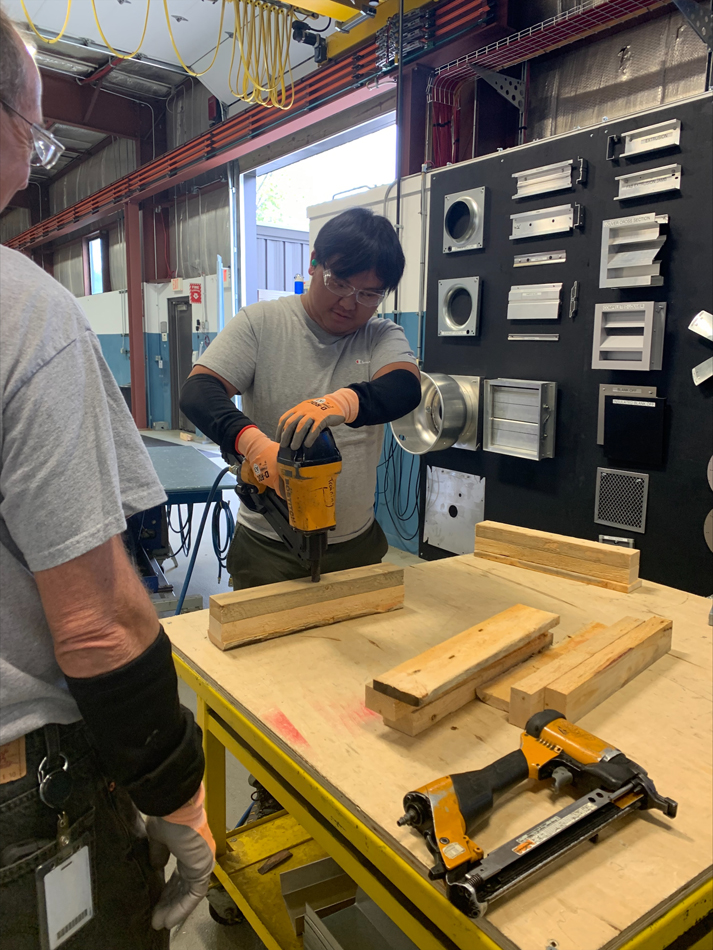
Michelle
Rothmeyer
Coordinator of Communications
D.C.
Everest Area School District
After months
of preparation, brainstorming, and a good faith effort to define and prepare
for all the “what ifs” — the Greenheck Everest Transition (GET) Academy was
launched in September 2021. The GET Academy is a
collaborative program between the D.C. Everest Area School District and
Greenheck Group (GG), a local manufacturer,
in conjunction with Northern Valley Industries that provides 18- to
21-year-old young adults with disabilities the opportunity to gain paid,
hands-on work experience. The program is designed to help students explore
career paths while gaining critical experience that will help them
transition to paid employment in the broader workforce.
The GET
Academy is basically structured as follows. Students follow the D.C. Everest
Senior High academic calendar, observing the same holidays, in-service days,
and inclement weather days. During the first semester, students spend a
portion of their day learning valuable employability skills in an on-site
classroom setting, then explore their career interests by job shadowing at
GG. Based on their interests, students apply to and interview for 2 - 3
possible rotations. Students are selected for one rotation after
interviewing and then begin their first 14-week on-site paid work
experience. This process is repeated at the start of the second semester.
All of the
students who graduated from last year’s inaugural class are employed. The
success of the GET Academy can be attributed to the thoughtful planning,
continuous communication and collaboration, and dedicated mentoring and
transitional support provided by all those involved.
When the DCE
Special Education department began brainstorming how they could provide
students with a work-based learning experience, they focused on constructing
a program that not only immersed students within the work environment, but
provided them with a support network that set them up for success. “We knew
it wasn’t enough to simply find a suitable work environment for our students
and supplement it with classroom training,” notes DCE Director of Special
Education Julie Weller. “We had to identify a company whose work culture
would support student mentorship and an organization with the experience and
tools to operationalize the concept.” DCE began collaborating with Northern
Valley Industries (NVI), a non-profit business and human service agency
dedicated to providing individuals with disabilities opportunities for
employment and transitional services. Both entities settled on GG as the
ideal partner for providing work experience — they have developed a 57-year
relationship with NVI and supported the DCE district with assorted job
shadowing, internship, apprenticeship, and mentoring opportunities for
years.
When asked
if the GET Academy could exist without any of the three organizations, every
respondent agreed: no, it could not. “NVI has the resources and experience
schools and businesses can use. We serve as the employer of record and
provide job development and long-term transitional support,” notes Sherri
Waid, NVI President. GG provides the
critical work experience and mentors. And DCE identifies GET Academy
participants and provides the student wages and a specialized instructor to
work one-on-one with students.
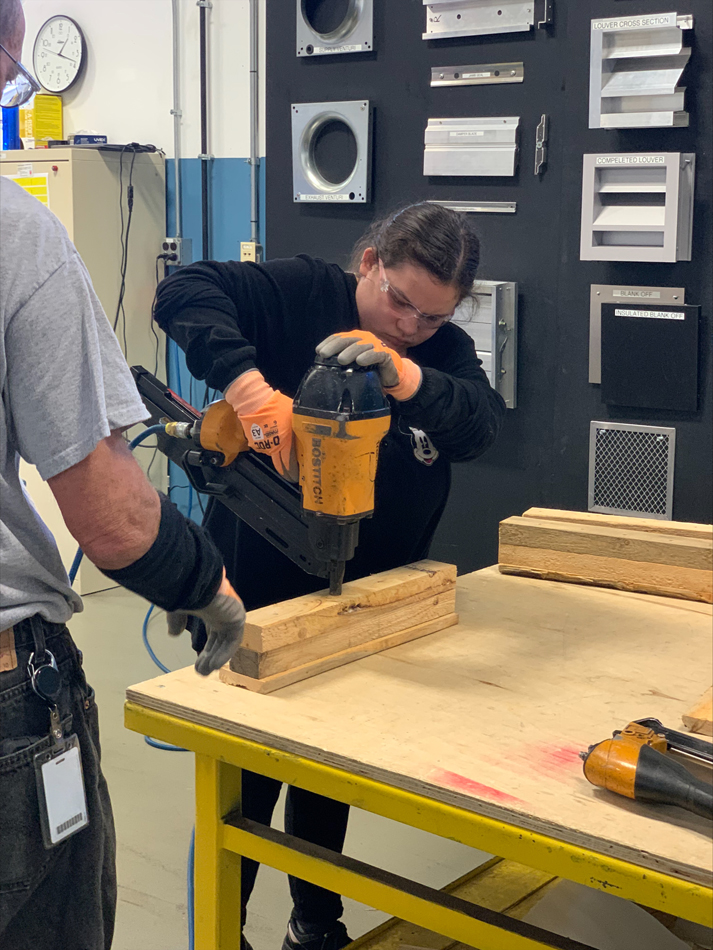
“Our role is
to provide a work environment for GET participants that allows them to get a
real world experience and we mimic a regular employment situation as much as
we can,” Monica Kummerfeldt, Recruiting Manager for GG, shares. “We created
roles within the organization that were appropriate and suited to the
students’ abilities,” she adds, and the HR team partnered with the union to
carve out part-time, first-shift positions for the students so they could
work with and be mentored by the most experienced employees. Human Resources
Manager, Danille Bump, has taken a leadership role communicating with
internal teams and supervisors to get the work environment, mentors, and
employees prepared to work with the students. One of the most critical
pieces, according to Kummerfeldt, is “making certain our mentors are fully
on board and committed. We identify leaders who are passionate about
mentoring students and who have the interest and ability to spend time with
the student. We also ensure we have a backup mentor in place for when that
person isn’t available.”
At the start
of the semester, students tour the facilities to get a feel for the actual
work environment and the people they would work with. “This helps them
determine what their interests are and to consider the noise levels or other
things in the environment they may not be comfortable with,” clarifies
Kummerfeldt. Simultaneously, Sue Schlinkmann, GET Academy Teacher and
Transition Liaison, works with students in an on-site classroom to develop
their resumé, interview, and job skills — focusing on what they need to do
to gain and maintain employment. As their case manager, Schlinkmann works
closely with each student to develop and help them meet their transition
goals and develop personal independence. One of the biggest challenges, she
notes, is that each class of students has different needs, abilities, and
personalities. “We need to take that into account when teaching job
placement and basic life skills for our students and make the classroom
lessons and setting unique to their needs.” Last year, for example, none of
her students were prepared to get their driver’s license but this year she
has students who are. Recently, she accompanied a student to the Department
of Motor Vehicles and advocated on his behalf to ensure he received the
accommodations he was entitled to when taking the driver’s test. “His goal
is to gain full-time employment, earn enough money to purchase a car, and
become independent. My goal is to help him accomplish that,” she adds. She
also helps students navigate other transitional skills such as planning
their meals and grocery shopping.
Once the
students are hired, they join GG’s regular new hire orientation. They also
take part in a small-group, four-day hands-on manufacturing training.
Throughout their 14-week work experience students are mentored, guided, and
supported by a network of individuals, including NVI and DCE job coaches and
GG department supervisors, employees, and mentors. Amy Dettman, NVI
Transition Youth Program Coordinator, serves as the communication liaison
between DCE, NVI, and Greenheck Group providing consistent updates and
hosting monthly team meetings. Her role is to operationalize the day-to-day
experiences for students and to ensure they have what they need — everything
from job coaching to transportation. She also coordinates long-term
transitional services. GET students are treated like regular employees so if
there is a behavioral, work quality, or attendance issue they are held to an
equal level of responsibility as their peers. Dettman and Schlinkmann also
turn these moments into learning situations for the students.
Now in its
second year, the GET Academy has made some adjustments based on feedback
from the students, employees, and mentors. “This was new to all of us,”
observes Kummerfeldt. “There were a lot of questions and ‘what ifs,’ and we
knew we wouldn't be able to figure it out until we were faced with them.”
Last year, they discovered it was challenging for participants to go from a
5-hour work day to an 8- hour workday so this year students transition
through three work phases. As they show progression, their workday hours
increase and they are rewarded for their successes with an incremental pay
increase. In addition, the job skills lessons are now held on-site at GG
rather than a DCE classroom to better integrate the learning piece with a
work-based setting. Students also end their days participating in the “Move
to Manufacturing” online course that provides basic manufacturing skills
training and will help students earn a certificate that differentiates them
from their peers. The program also has initiated more career-focused
conversations with the students and their families earlier and throughout
the process because as the students develop their skills and demonstrate
their preparedness for full-time employment, “We want them to go for it,”
adds Schlinkmann.
The program
also has further developed the mentoring process. “The most important thing
is that students have a go-to person,” states Schlinkmann. “I’m there to
support them, but I don’t know how to assemble a louver — they can’t learn
that from me.” Further, students and mentors develop significant social
relationships. “Students have received personal gifts from employees, we
celebrate their birthdays and their graduation from the program — we make
sure they’re part of the organization and we take joy from working with
them,” adds Kummerfeldt. Beyond gaining critical work skills, the sense of
being a part of something is perhaps even more significant.
As
manufacturing businesses continue to face hiring challenges, the success of
the GET Academy has DCE, GG, and NVI considering the possibilities of
growing the model. “Right now, businesses have the opportunity to get
creative, shift their thinking, and consider different populations like
at-risk youth as potential employees.” Kummerfeldt agrees. “The GET Academy
has made me think about other groups who would benefit from these
opportunities and may need a head start.” Concludes Schlinkmann, “Our
students’ success here or at any other business makes them realize they can
do more. It gives them some confidence, allows them to be a part of
something bigger, and changes their whole outlook because they can see
what’s possible.” Ultimately, a work-based learning model that expands the
realm of possibilities for young people is beneficial across the board for
schools, students, families, communities, and businesses.
https://www.dce.k12.wi.us/
Fab-ulous
news: Big Foot High School, Fontana Elementary receive joint $32,399 WEDC grant
to update, expand fab lab facilities
By Eric
Johnson for the Lake Geneva Regional News
Reprinted
with permission
Area
students in two local school districts will have more cutting-edge technology
for learning 21st Century workforce skills when they return to school this fall.
The Wisconsin Economic
Development Corporation (WEDC) announced May 18 that Fontana Joint 8 School
District and Big Foot Union High School will receive a $32,399 state grant to
expand the facilities in their existing fabrication laboratory, or “fab lab,” to
better equip students with essential skills for the global economy.
Fontana Elementary enrolls around
200 students, and Big Foot around 500.
“Anytime we can get new and
updated technology into our student’s hands, it just helps them be more prepared
for the next level of the workforce,” said Jeremy Andersen, Big Foot’s principal
since 2020. “These materials change so fast that we want to try to stay as
up-to-date as possible, so it’s really exciting for our kids to be able to have
most industry-ready materials in their hands for practice and learning. It (fab
lab) is a great exploratory. It’s a wide-open field. I’m amazed most days at
what they’re doing.”
Big Foot’s portion of the grant
is around $25,000, according to Andersen. Big Foot will be adding a Formlab Form
3L large format 3D digital printer and associated equipment.
Including Fontana and Big Foot,
21 school districts throughout the state are being awarded a total of $508,030
in Fab Lab grants this year.
“We are excited to be able to
build upon what we were able to acquire last year, the first year of our new Fab
Lab,” said Fontana district administrator Mark Wenzel. “We appreciate the
financial assistance from the WEDC. Our students will be able to be provided
hands-on experiences in 21st Century technology skills.”
Fontana fab lab
Fontana Elementary School
principal Steve Torrez said a grant awarded last spring funded a reconfiguration
and resign of the school library for the 2021-2022 school year to add a fab lab
featuring 3D printers, laser cutters and “greater access to greater technology
for the kids.”
The fab lab is under the
direction of librarian and 21st Century coordinator Annelise Gutierrez.
Torrez said
an Elkhorn-based furniture manufacturer assisted Fontana
Joint 8 School District with writing last year’s grant and later assisted the
school with the redesign of the library space for the fab lab facility. The firm
also assisted with the purchase and set-up of fab lab design software and
equipment including 3D printers and laser cutters, as well as professional
development for school staff involved with the fab lab.
Among the cross-curricular
connections to arise out of the fab lab, Torrez noted, is use of the fab lab for
art applications, including educational decorative wall designs for the
pre-school area and the creation of t-shirt apparel for band, sports and other
groups.
Other
technology offerings at Fontana Elementary School, Torrez said, includes the
school’s drone club and a curriculum expansion partnership with the local
technical college in areas including drone flight, 3D design, CAD software, and
career and college readiness.
The recently-announced shared
grant award for the 2022-2023 school year, Torrez said, came out of a
“partnership with Big Foot to expand and allow some connection from middle
school into high school.”
“That will hopefully expand not
only the opportunities for our kids, but also carry over what they learned here
into high school and beyond,” he noted.
Part of
Fontana Elementary School’s fab lab technology expansion, Torrez said, is
student exposure to green energy engineering and future STEM employment
opportunities through the school’s collaboration with Lake Geneva-based
commercial and industrial solar developer which installed a small rooftop solar
array at the school in April.
“The array of opportunities and
employment that come with solar is diverse,” Torrez said. “It’s not just green
energy and solar, it’s engineering, it’s construction, it’s developing, it’s
building, it’s typography. We’re just trying to layer-up and expose kids to
multi-multi-faceted opportunities that come with it.”
The solar
developer’s president John Kivlin said development of the small solar array at
Fontana Elementary School had its roots in several years of discussions with
Torrez.
“We donated part of the array,
with a grant from the state for part of the array and the balance the school has
agreed to pay,” he noted. “It was a collaborative one third, one third, one
third share. Living here in the community, it’s a good opportunity to give a
little something back.”
Kivlin said the “small
demonstration system” solar array will provide educators with monitoring and
performance data to explain how solar works and allow students to see real-time
performance.
“There’s some good opportunities
for the kids to look at it and form questions of their own that will lead to who
knows what,” Kivlin said.
“Scientists and engineers of the
future,” Torrez replied.
“Or in the
present,” Kivlin said.
Big Foot fab lab
Development of the fabrication
laboratory at Big Foot High School was spearheaded by retired 11-year principal
Mike Hinske, a veteran 38-year Big Foot educator.
Hinske, who retired in June 2018,
successfully wrote for a grant to establish a fab lab at Big Foot in the 2014-15
school year, and later worked on securing the high tech equipment required for
outfitting the new facility, establishing its engineering curriculum, and
putting a SolidWorks computer-aided design and engineering application in place.
“The idea was when kids got out
of there they’d have either a technical certification or they would have
experience using SolidWorks and/or digital fabrication,” recalled Hinske, an
18-year administrator and former physical education teacher and football and
wrestling coach at Big Foot. “They could either move into an apprenticeship or
something in the field of work, technical college, technical school program.”
A “really important piece” of
launching the fab lab, he said, was a push to get more women involved in the
STEM professions.
The end result of adding the fab
lab, Hinske noted, was Big Foot found itself having “a number of kids ending up
in engineering programs and engineering schools” and more students overall
“going into engineering in general.”
“All of a
sudden we started to see more and more of a push towards engineering,” he
recalled. “We had kids going to Milwaukee, we had them going to Madison for
engineering, we had them going to Case Western Reserve in Ohio. We had a lot of
kids going to prep for engineering, which was positive. It gave kids the
opportunity to explore that.”
Beyond engineering, Hinske said
fab labs have complementary natural applications in other fields including
interior design and the arts.
An important part of the Big Foot
fab lab, Hinske said, has been building partnerships with “community businesses
that are supportive of engineering.”
“There’s a lot of companies here
that use engineering, that use SolidWorks,” he noted. “They need people. They
need high quality, trained people to help them.”
Big Foot district administrator
Doug Parker is pleased with the success of the high school’s maturing fab lab
program.
“It’s a great exploratory to
another pathway of careers,” he noted. “We’re a comprehensive high school. We
can’t offer everything, but we try and offer as many career pathways and
exploration opportunities as we can. The better the equipment and the more
equipment we have, the more things we can expose kids to in the engineering
field and allow them to explore that career pathway, and hopefully, if they’re
interested, go on to post-secondary and careers in the field.”
In regard to
the current grant award, Parker said he is “hopeful” that the fab lab expansion
grants will help both programs establish a solid fab lab program continuum “that
is the start of a great engineering transition” for students advancing from
Fontana to Big Foot.
https://www.bigfoot.k12.wi.us/
https://www.fontana.k12.wi.us/
Non-profit’s
manufacturing camp trains an untapped resource of workers
By Emily
Matesic for WSAW
An Appleton non-profit hopes a camp it’s hosting
will help fill vacancies in manufacturing by training an untapped resource of
potential workers.
VPI is a non-profit that already works with
individuals who have disabilities or are disadvantaged. When an opportunity
arose to continue its mission and help even more people, as well as the
manufacturing industry, VPI was on-board.
A group of 10 young adults are part of Inclusion
Manufacturing Camp in Appleton.
“I like it here a lot because I like to try new
jobs,” camper Noah Berken said.
The idea of the four-week camp is to train and
prepare young adults with disabilities for jobs in manufacturing.
Monica Allaback is an instructor for VPI. ”We’ve
seen a lot of improvement in social skills, talking to their supervisor, being
able to ask questions if they need to, and just learning the jobs. They are
doing great,” Allaback said.
The lessons learned here are showing local employers
that this group of individuals is a viable option to meet workforce demands.
By building the skills, campers say they’ve built up
confidence that will help to empower them as they search for jobs and careers.
“It taught me that I can go, be what it’s like in
the real world and be OK with it,” camper Keegan Glaser said.
”It gives people purpose in life. It gives people a sense of being part of the
community -- and just plain old cash. The other reason why we’re doing this is,
we really want to encourage people to find a job in manufacturing. There’s a lot
of great jobs out there and a lot of great people to do them,” Allaback said.
For the full story go to:
https://www.wsaw.com/2022/08/16/non-profits-manufacturing-camp-trains-an-untapped-resource-workers/
The Rise of Skilled Manufacturing
From the Wisconsin Historical Society
Between 1870 and 1900 the United States became the world's foremost industrial
nation, emerging as the leader in meatpacking, timber and steel production as
well as in mining. The nation experienced a stunning growth in the scale and
pace of industrial production, which transformed business, the environment, the
workplace, the home, and everyday life. In Wisconsin, early manufacturing was
primarily extractive - - removing raw materials such as fur, lumber, and lead
from the landscape and processing them for market. In contrast, by 1860
Milwaukee had become a center of modern manufacturing - - creating finished
consumer goods from those raw materials. Its lumber and flour milling industries
produced one-fourth of the value of all manufactures in the state that year.
Read more and find images, books and articles here:
http://www.wisconsinhistory.org/turningpoints/tp-044/?action=more_essay
Manufacture
Your Future
Arconic Foundation and Discovery Education have partnered to provide 3rd-12th grade
educators, administrators, school counselors and families with materials to
cultivate the next generation of manufacturing leaders and innovators. New
lesson plans and self-paced module are rooted in STEM principles, and counselor
and family resources explore career options and provide a school-to-home
connection.
https://www.manufactureyourfuture.com/
MFG DAY
Held
annually on the first Friday in October, Manufacturing Day helps show the
reality of modern manufacturing careers by encouraging thousands of companies
and educational institutions around the nation to open their doors to students,
parents, teachers and community leaders. October 4, 2019.
https://www.mfgday.com/
Fabrication
Laboratories (Fab Labs) Program resources from the Wisconsin Economic
Development Corporation (WEDC)
https://wedc.org/programs-and-resources/fabrication-laboratories-resources/
Wisconsin
Manufacturing Facts from the National Association of Manufacturers (NAM)
https://www.nam.org/state-manufacturing-data/2019-wisconsin-manufacturing-facts/
Tools and
Resources for Educators from the Manufacturing Institute
http://www.themanufacturinginstitute.org/Skills-Certification/Educator-Resources/Tools-and-Resources.aspx
Depth Over
Breadth
Students earn about 2 percent more annually for each advanced or upper-level
vocational class they take in high school, according to a new
analysis. Authors Daniel Kreisman of Georgia State
University and Kevin Stange of the University of Michigan also report that,
rather than deterring capable students from academic pursuits, vocational
courses enable students to make better post-secondary enrollment decisions.
https://www.educationnext.org/depth-over-breadth-value-vocational-education-u-s-high-schools/
| 
